Flowchart
flowchart TD
    Start(**Tachykardes VHF/VHFla**):::mStart --> ABCDE{{"**ABC-Instabil?**<br>Schock, Vigilanz↓, AP, Lungenödem"}}:::mCritical
    ABCDE -->|Ja| Bedarf{{**Bedarfstachykardie?**}}:::mImportant
    Bedarf -->|Nein| eKV(**elektr. Kardioversion**<br>in Analgosedierung)
    eKV --> SR{{**Sinusrhythmus?**}}
    SR --> |Nein| Korrektur("Patches optimieren (AP),<br>Elyte hochnormal,<br>1x MgSO4 2g i.v.",<br>ggf. Amiodaron 150 mg KI)
    Korrektur --> |max. 3x wiederholen<br>danach: RS Kardiologie| eKV
    Bedarf -->|Ja| U(**Ursache behandeln**<br>Bedarfstachykardie<br>akzeptieren)

    ABCDE --> |Nein| Bedarf2{{**Bedarfstachykardie?**}}:::mImportant
    Bedarf2 -->|Ja| U
    Bedarf2 -->|Nein|HF{{**HF ≥110/min**}}
    HF --> |Ja| FK(**Frequenzkontrolle**<br>Betablocker titriert p.o.)
    HF --> |Nein| Dispo(**Disposition**<br>ambulant möglich?)
    FK --> HF

    click ABCDE "/ABCDE"
    click eKV "/eKV"
Rapid Reference Instabiles VHF
- HF >>1501
- New-onset VHF
- Atrial Kick dependent Erkrankungen (Pulmonale Hypertonie, AS, MS, HFpEF)
- FBI (WPW+VHF)
- Frequenzkontrolle vs. Rhythmuskontrolle
- bei oligosympt. Älteren eher nur Frequenzkontrolle
- eKV bei stabilem VHF möglich?
- AK >3 Wochen (Adhärenz? Bei VKA: INR >2.0) oder
- Onset <12h oder Onset <48h + CHADS65 ≤2 (HFrEF, HTN, ≥65 J., Diabetes) oder
- TEE LAA-Thrombus negativ
- Elektrolyte?
- Volumenstatus?
- Sympathikotonus?
- Medikamente/Intox?
DD TAA Trigger (PIRATES)
Ursache aggressiv behandeln, Bedarfstachykardie akzeptieren
- P–Pulmonary Embolism
- I–Ischämie
- R–Rheumatisches Fieber
- A–Alkohol, Anämie
- T–Thyreotoxikose, Toxisch
- E–Elektrolyte (insb. HypoK+, HypoMg2+), Exsikkose
- S–Sepsis, Stress
Symptomlast n. EHRA
- EHRA 1 asymptomatisch
- EHRA 2a ADL nicht beeinflusst
- EHRA 2b ADL nicht beeinflusst, aber Pat. fühlt sich belastet
- EHRA 3 ADL beeinträchtigt
- EHRA 4 Normale ADL nicht mehr möglich
Workup
- Ätiologie:
- Herzinsuffizienz
- Ischämisch (KHK)
- Kardiomyopathie
- Elektrolyte (insb. HypoK+)
- RHB (LAE, COPD, Pulmonale Hypertonie)
- Myokarditis
- Valvuläres VHF: insb. Mitralklappenstenose
- Holiday-Heart-Syndrom: Paroxysmales VHF nach Alkoholexzess
- Labor: HypoK+? HypoMg2+? Hyperthyreose? ggf. Digitalis-Spiegel?
Frequenzkontrolle
- MgSO4 2g in VEL
- Kalium hochnormal >4.0 mmol/l
- Betablocker
- Alternative Calciumantagonisten bei KI Betablocker
- KI: Hausmed Betablocker, LVEF <40%, Hypotonie
- Verapamil 2.5 mg-weise i.v. bis ∑10 mg
- Last Resort Kombination mit Betablocker unter ITS-Monitoring (entgegen Fachinformation, klare KI, in RS OA)
- Alternative Digitalis (z.B. Hypotonie, stark reduzierte LVEF)
- KI: HypoK+
- Digoxin (Lanicor) 0.25 mg langsam i.v. 1x wdh nach 4h
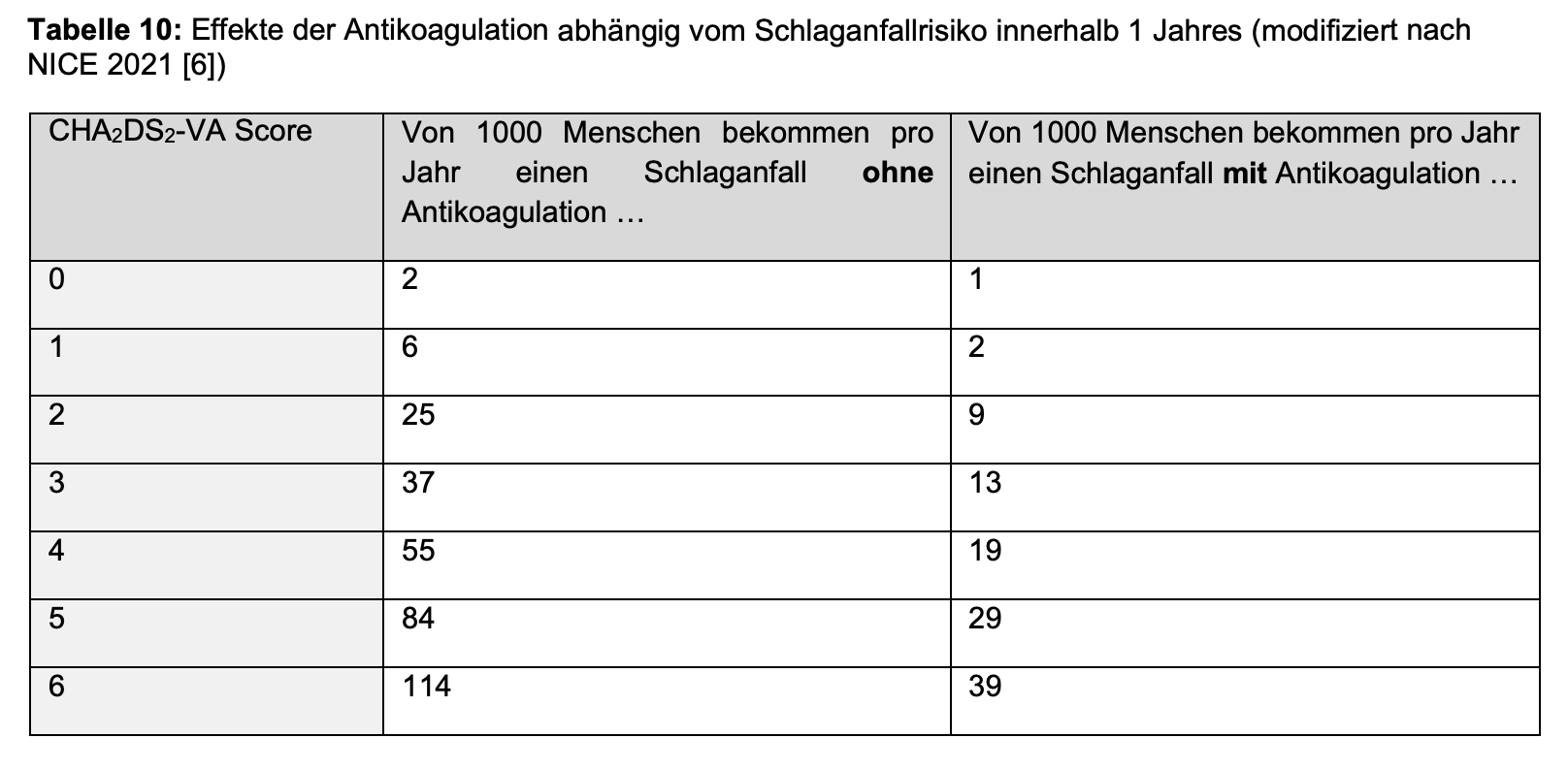
Antikoagulation bei VHF
Textbaustein Stationär
Zusammenfassend Tachyarrhythmia absoluta bei ### ED/Rezidiv eines Vorhofflimmerns. Kontinuierliches Monitoring. Substitution von Kalium und Magnesium. Frequenzkontrolle mit kumulativ ### mg Metoprolol ### i.v./p.o., hierunter HF von ### auf ### stabilisiert.

Bei CHA2DS2VA-Score ###≥2 Pkt. und HAS-BLED ###≤2 Pkt. Indikation zur therapeutischen Antikoagulation. Diese nach Aufklärung (insb. Blutungszeichen und Verhalten bei Verletzungen) mit Apixaban p.o. initiiert. ### Reduzierte Dosis?

Kardiologische normalstationäre Aufnahme.
Textbaustein Ambulant in nfVHF
Zusammenfassend Tachyarrhythmia absoluta bei ### ED/Rezidiv eines Vorhofflimmerns. Kontinuierliches Monitoring. Substitution von Kalium und Magnesium. Frequenzkontrolle mit kumulativ ### mg Metoprolol ### i.v./p.o., hierunter HF von ### auf ### stabilisiert.

Bei CHA2DS2VA-Score ###≥2 Pkt. und HAS-BLED ###≤2 Pkt. Indikation zur therapeutischen Antikoagulation. Diese nach Aufklärung (insb. Blutungszeichen und Verhalten bei Verletzungen) mit Apixaban p.o. initiiert. ### Reduzierte Dosis?

Bei geringer Symptomlast und suffizienter Frequenzkontrolle Entlassung in gebessertem AZ. ### Elektive Wiedervorstellung zur Rhythmisierung terminiert.

Erklärung für Patient:innen:
Ursache Ihrer Beschwerden ist eine Herz-Rhythmusstörung (”Vorhofflimmern”), die zu einem unregelmäßigen Herzschlag führt und Herzrasen verursachen kann. Bei Vorhofflimmern besteht ein erhöhtes Risiko für Schlaganfälle durch die Bildung von Blutgerinnseln, weswegen das Blut medikamentös “verdünnt” werden sollte. Durch die Einnahme des Gerinnungshemmers (Apixaban/Eliquis) wird das Schlaganfall-Risiko deutlich gesenkt. Durch ### Metoprolol/Bisoprolol wird der Herz-Rhythmus regelmäßig gehalten und dem Auftreten von Herzrasen vorgebeugt.

Empfehlungen:
- "Blutverdünner": Apixaban 5 mg 1-0-1
	- Immer Ärztliche Vorstellung bei Blut im Stuhl oder schwarzem Stuhlgang sowie bei Kopfverletzung
	- Bei Wunden oder Nasenbluten lässt sich die Blutung i.d.R. dennoch durch kräftigen, ununterbrochenen Druck für min. 5 min stoppen
- Für den Herzrhythmus: Bisoprolol 2.5 mg 1-0-0
- Kardiologische Vorstellung ### Ambulanz/Station # am ### um ###; Versichertenkarte und hausärztliche Einweisung mitbringen
- Bei Brustschmerzen, Schwindel oder Luftnot Wiedervorstellung über eine Notaufnahme
Textbaustein Ambulant spontan konvertiert
Zusammenfassend Tachyarrhythmia absoluta bei ### ED/Rezidiv eines Vorhofflimmerns. Kontinuierliches Monitoring. Substitution von Kalium und Magnesium. Frequenzkontrolle mit kumulativ ### mg Metoprolol ### i.v./p.o., hierunter HF von ### auf ### stabilisiert.

Bei CHA2DS2VA-Score ###≥2 Pkt. und HAS-BLED ###≤2 Pkt. Indikation zur therapeutischen Antikoagulation. Diese nach Aufklärung (insb. Blutungszeichen und Verhalten bei Verletzungen) mit Apixaban p.o. initiiert. ### Reduzierte Dosis?

Im Verlauf Spontankonversion in den normofrequenten Sinusrhythmus. Entlassung in gebessertem AZ.

Erklärung für Patient:innen:
Ursache Ihrer Beschwerden ist eine Herz-Rhythmusstörung (”Vorhofflimmern”), die zu einem unregelmäßigen Herzschlag führt und Herzrasen verursachen kann. Bei Vorhofflimmern besteht ein erhöhtes Risiko für Schlaganfälle durch die Bildung von Blutgerinnseln, weswegen das Blut medikamentös “verdünnt” werden sollte. Durch die Einnahme des Gerinnungshemmers (Apixaban/Eliquis) wird das Schlaganfall-Risiko deutlich gesenkt. Durch ### Metoprolol/Bisoprolol wird der Herz-Rhythmus regelmäßig gehalten und dem Auftreten von Herzrasen vorgebeugt.

Empfehlungen:
- "Blutverdünner": Apixaban 5 mg 1-0-1
	- Immer Ärztliche Vorstellung bei Blut im Stuhl oder schwarzem Stuhlgang sowie bei Kopfverletzung
	- Bei Wunden oder Nasenbluten lässt sich die Blutung i.d.R. dennoch durch kräftigen, ununterbrochenen Druck für min. 5 min stoppen
- Für den Herzrhythmus: Bisoprolol 2.5 mg 1-0-0
- Bei erneutem Herzrasen/Herzstolpern kardiologische Vorstellung; bei zusätzlich Brustschmerzen, Schwindel oder Luftnot über eine Notaufnahme
Textbaustein Diagnose VHF
Aktuell: Intermittierendes/Persistierendes/Permanentes, bradykardes/normofrequentes/tachykardes Vorhofflimmern (VHF), ED ###
- ##.##.####: CHA2DS2-VASc: ###
- ##.##.####: eKV
- ##.##.####: Ablation
- OAK mit
Literatur
- S3-Leitlinie Vorhofflimmern
- Koffein verursacht wahrscheinlich zumindest kein VHF, in 1 RCT sogar geringere Recurrence2
Footnotes
-
HF 120-180 normalerweise maximal ohne AV-Block / neg. Dromotropie, bei >200/FBI DD VHF + WPW ↩
-
Wong CX. Caffeinated Coffee Consumption or Abstinence to Reduce Atrial Fibrillation: The DECAF Randomized Clinical Trial. JAMA. 2025 Nov 9:e2521056. doi: 10.1001/jama.2025.21056. Epub ahead of print. PMID: 41206802; PMCID: PMC12598581. ↩